Can a 3.6kW Solar System Work With 10 Panels?


When looking at a solar and battery system, one of the most common questions is:
“If the inverter is 3.6kW, why have I got more than 3.6kW of solar panels?”
It is a fair question, especially when a quote or invoice shows something like:
10 x 455W solar panels = 4.55kWp solar arraySigen 3.6kW Energy ControllerSigenergy SigenStor 9kWh battery storage
At first glance, it can look as though the solar panels are too large for the inverter. However, that is not how a hybrid solar and battery system should be understood.
A 3.6kW inverter does not automatically mean you can only have 3.6kW of solar panels. The important thing is to understand the difference between the solar panel capacity, the inverter’s AC output, and the way the battery can store excess generation.
Panel size and inverter size are not the same thing
Solar panels are usually described in kWp, which means kilowatt peak. This is the rated output of the panels under standard test conditions.
For example:
8 x 455W panels = 3.64kWp
10 x 455W panels = 4.55kWp
That does not mean the panels will produce that amount all day. Solar generation changes constantly depending on the weather, roof direction, time of year, shading, panel temperature and the angle of the sun.
In real life, solar panels spend a lot of time producing below their maximum rated output. They may only reach or get close to their peak output for shorter periods in the best conditions.
The inverter has a different job. It controls how much power can be converted and supplied as AC electricity to the property or the grid at any one time.
What the 3.6kW Sigen Energy Controller can handle
The Sigen 3.6kW Energy Controller has a nominal on-grid AC output of 3.68kW.
However, the same unit can accept significantly more solar panel capacity on the DC side. The Sigen 3.6kW single-phase Energy Controller has a maximum PV input of 7.36kW.
This means a system with:
10 x 455W panels = 4.55kWp
is still well within the Sigen 3.6kW unit’s PV input capability, provided the full electrical design is correct.
The key point is this:
The 3.6kW figure relates to the inverter’s AC output. It does not mean the solar panel array has to be limited to 3.6kWp.
Why fit 10 panels instead of 8?
Eight 455W panels would give a solar array of around 3.64kWp, which looks very close to the 3.68kW inverter output.
That may look like a neat match on paper, but it is not always the best real-world design.
Adding two more panels increases the array to 4.55kWp. This can help the system produce more energy across the day and across the year, especially during:
mornings
evenings
cloudy periods
winter months
lower-light conditions
The aim of a good solar design is not just to achieve the highest possible peak at midday in summer. The aim is to generate as much useful energy as possible over the course of the year.
In many cases, a slightly larger solar array helps the system perform better for longer periods, even if there are occasional moments where peak output is limited.
What happens when the panels produce more than 3.68kW?
This is where the battery makes a big difference.
With a simple solar-only inverter, if the panels are producing more than the inverter can convert to AC, some of that energy may be clipped. Clipping means the inverter caps the output because it cannot convert any more power at that moment.
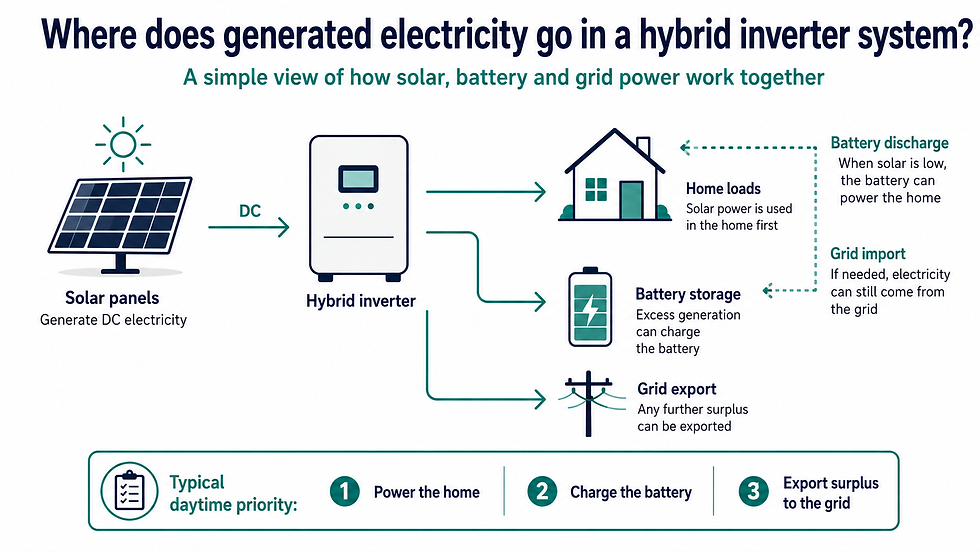
With a hybrid solar and battery system, there is another route for some of that excess energy.
The solar energy can be:
used directly by the home
stored in the battery
exported to the grid
limited or clipped if there is nowhere useful for it to go
So, if the panels are producing strongly and the home is not using all of that energy, the battery can charge from the surplus, provided the battery has available capacity and the system settings allow it.
This is one of the reasons why pairing a larger solar array with battery storage can work well. The battery helps capture energy that might otherwise have been exported or, in some situations, clipped.
The battery does not remove every limit
It is important to be clear: the battery does not mean there are no limits at all.
The inverter still has a maximum AC output. On this system, the maximum on-grid AC output is 3.68kW.
The battery also has its own charge rate, state of charge and operating limits. If the battery is already full, or if the system settings are prioritising export rather than charging, the system may behave differently.
There may still be some short periods where solar generation is higher than the house can use, the battery can take, or the inverter can export. In those situations, some clipping can occur.
That is not necessarily a sign of a poor design. A small amount of clipping at peak times can be acceptable if the larger solar array improves the overall generation across the year.
How system settings affect where the energy goes
The Sigen system can operate in different modes, and these settings affect how energy is used.
In a typical self-consumption setup, the system will usually prioritise the home first. Solar power is used to run the property, then surplus energy charges the battery. If there is still more surplus after that, it can be exported to the grid.
In a more export-focused setup, the system can be set to prioritise sending energy to the grid. Where solar generation is above the inverter’s maximum output, the inverter can remain at its maximum output while excess energy is stored in the battery if capacity is available.
There are also time-based settings, where the battery can be charged or discharged around electricity tariffs. This can be useful for customers on time-of-use tariffs, where electricity is cheaper at certain times of day and more expensive at others.
The same panels, inverter and battery can therefore behave differently depending on how the system is configured.
Example: 10 x 455W panels with a 3.6kW Sigen and 9kWh battery
This system has:
Solar array: 10 x 455W panels = 4.55kWpEnergy Controller: Sigen 3.6kWMaximum PV input: 7.36kWMaximum on-grid AC output: 3.68kWBattery storage: 9kWh
The 4.55kWp solar array is comfortably within the Sigen 3.6kW Energy Controller’s PV input capability.
At certain times, the panels may produce more than the inverter’s 3.68kW AC output. When that happens, the system can still use the energy intelligently. The home can use some of the generation, the battery can take surplus energy where capacity is available, and the grid can receive exported power up to the permitted output limit.
This means the system is not simply “wasting” the extra two panels. Those panels can help increase useful generation for more of the year.
The simple way to think about it
A 3.6kW inverter does not mean you are limited to 3.6kW of solar panels.
It means the inverter has a maximum AC output of around 3.68kW. The solar panel input capacity can be higher, and on the Sigen 3.6kW Energy Controller, the maximum PV input is 7.36kW.
With 10 x 455W panels, the solar array is 4.55kWp, which is within the Sigen unit’s capability.
The battery then gives the system more flexibility, allowing surplus solar energy to be stored instead of immediately being exported or clipped, subject to battery capacity, settings and operating conditions.
Final takeaway
The best solar system is not always the one where the panel size and inverter size match exactly.
A well-designed system considers:
how much electricity the property uses
when the electricity is used
roof space and panel layout
inverter input and output limits
battery size and charge rate
export limits
tariff settings
future energy use, such as EV charging or heating
In this example, 10 panels on a 3.6kW Sigen system is not automatically oversized or incorrect. It is a common design approach where the inverter output, solar input and battery storage all work together to increase useful generation across the year.
The key is making sure the system has been designed within the manufacturer’s limits and configured correctly for how the customer wants to use their energy.


Comments